
Featured

U.S. Officials Say Iran’s New Supreme Leader Gravely Wounded Amid Escalating Conflict

Protesters hold posters of Iran's late Supreme Leader Ayatollah Ali Khamenei and his son, Iran's new Supreme Leader Mojtaba Khamenei, during a protest marking al-Quds Day (Jerusalem Day), after Friday prayers at Fatih Mosque in Istanbul. U.S. Defense Secretary Pete Hegseth has confirmed that Iran’s newly appointed Supreme Leader, Mojtaba Khamenei , was seriously wounded and likely disfigured during the opening phase of U.S. and Israeli military strikes. Speaking at a Pentagon briefing, Hegseth described Iran’s leadership as “desperate and hiding,” asserting that Khamenei has gone underground following injuries sustained in the attacks.  Reports from multiple outlets indicate that Khamenei has not appeared publicly since the conflict began, fueling speculation about the severity of his condition. Some accounts suggest he may have suffered catastrophic injuries, including the loss of a limb and a possible coma, after an airstrike that also killed members of his family.  U.S....
article

EU Faces Crucial Choice: Swift U.S. Trade Deal or Strategic Patience

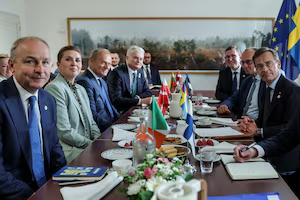
European Union leaders are meeting in Brussels today to determine whether to accept a fast-tracked trade agreement with the United States—despite its tough terms—or hold out for a more balanced deal, even at the risk of escalating tensions.

With a July 9 deadline set by President Donald Trump, the pressure is mounting. The U.S. currently imposes a 10% tariff on most EU goods, with even steeper rates—up to 50%—on steel, aluminum, and automobiles. EU officials fear these could rise further if no agreement is reached.

German Chancellor Friedrich Merz has voiced strong support for a quick resolution, emphasizing the need to avoid a deeper trade conflict. “It is in everyone’s interest that the trade conflict with the United States does not escalate further,” Merz told parliament.

The European Commission has proposed eliminating tariffs on industrial goods and increasing EU imports of U.S. liquefied natural gas and soybeans. However, Washington has shown little interest in these terms, focusing instead on regulatory issues the EU is reluctant to change.

Some EU countries are prepared to accept the 10% baseline tariff to protect their industries, while others advocate for retaliatory measures. The bloc has already approved tariffs on €21 billion worth of U.S. goods and is debating further actions targeting up to €95 billion more.

As leaders weigh their options, the outcome of this summit could shape transatlantic trade relations for years to come.

Comments